 New Delhi:
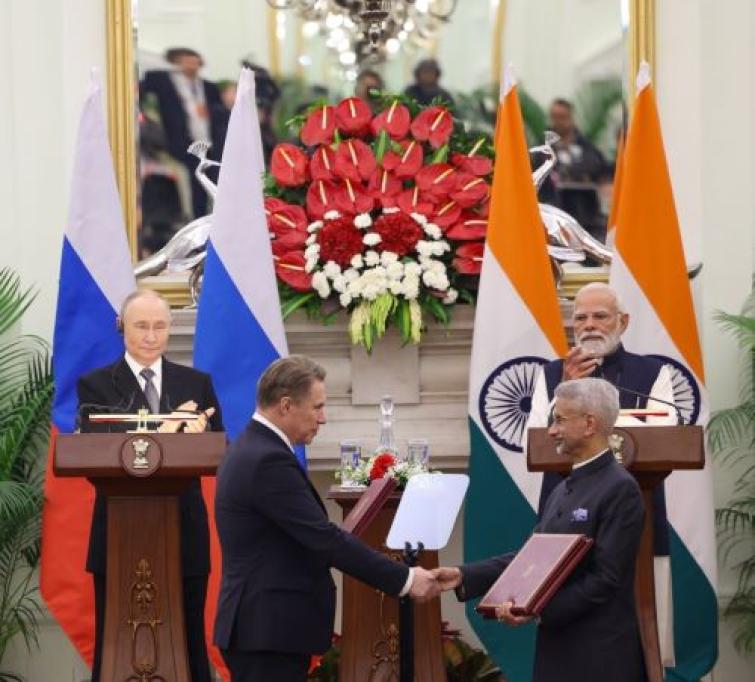
 India and Russia on Thursday reaffirmed the strength of their 'Special and Privileged Strategic Partnership,' positioning the long-standing relationship as a stabilising force in a shifting global order. The commitment came as Russian President Vladimir Putin arrived in New Delhi for the 23rd India–Russia Annual Summit on December 4–5, at the invitation of Prime Minister Narendra Modi. The visit coincides with the 25th anniversary of the landmark 2000 Strategic Partnership agreement.
Both leaders praised the trust-based friendship that has weathered geopolitical upheavals, underscoring their intent to unlock its full potential across defence, trade, technology, space, nuclear energy and cultural exchanges. The partnership, they noted, continues to thrive on mutual respect for national interests and an aligned vision of a multipolar, secure world.
Trade and connectivity dominated the talks, with both sides pushing to raise bilateral commerce to 'USD 100 billion by 2030', ensuring greater market access for Indian products and stronger investment flows. India and Russia welcomed the 'Programme 2030', a roadmap to deepen economic cooperation, and renewed momentum on a 'Free Trade Agreement' with the Eurasian Economic Union. They also agreed to expand payment settlements in national currencies and work toward interoperable digital financial systems.
Connectivity projects received a major boost, particularly the International North-South Transport Corridor, the Chennai–Vladivostok maritime route and the Northern Sea Route. New Indian Consulates in 'Yekaterinburg and Kazan' are expected to further open regional and economic linkages.
Energy collaboration remains a central pillar — from oil and gas supply and technology sharing to nuclear power cooperation. Progress on the Kudankulam Nuclear Power Plant was welcomed and discussions will advance for a second nuclear site in India, alongside future joint fuel and reactor development.
Defence cooperation — one of the strongest foundations of bilateral ties — is now being steered toward 'co-development and co-production in India' under the Make-in-India programme. Joint military exercises like 'INDRA' will continue to expand in scale and complexity.
Both sides pledged to intensify work in
emerging technologies, critical minerals, and cybersecurity. Academic and innovation partnerships will be strengthened to promote collaboration among universities, start-ups and research bodies.
Cultural and people-to-people cooperation also saw a push — from joint film production to easier visas and boosting tourism. Moscow’s participation in the 'International Big Cat Alliance' was welcomed, and New Delhi is hopeful Russia will soon join the 'International Solar Alliance and the Coalition for Disaster Resilient Infrastructure'.
India and Russia affirmed close alignment in global forums — the UN, G20, BRICS and SCO — reiterating support for
'UN Security Council reform' and India’s permanent membership bid. Russia pledged full backing for India’s 'BRICS Chairship in 2026'.
On
regional issues, the leaders stressed cooperation on 'Afghanistan', called for de-escalation and humanitarian protection in 'West Asia', and reaffirmed commitment to global counter-terrorism efforts. They strongly condemned terror attacks in both countries, including the 2025 Pahalgam attack in J&K and the 2024 Moscow concert hall assault.
Climate cooperation also advanced through joint work on low-carbon development and the Paris Agreement implementation, including the BRICS Climate Research Platform.
Concluding the summit, President Putin thanked Prime Minister Modi for the warm hospitality and invited him to visit Russia in 2026 for the next annual summit — a tradition that both sides see as a cornerstone of this enduring strategic partnership.