While the bilateral agreement governing the corridor has been extended until 2029, there is still little clarity on when pilgrims will once again be able to walk this sacred path.
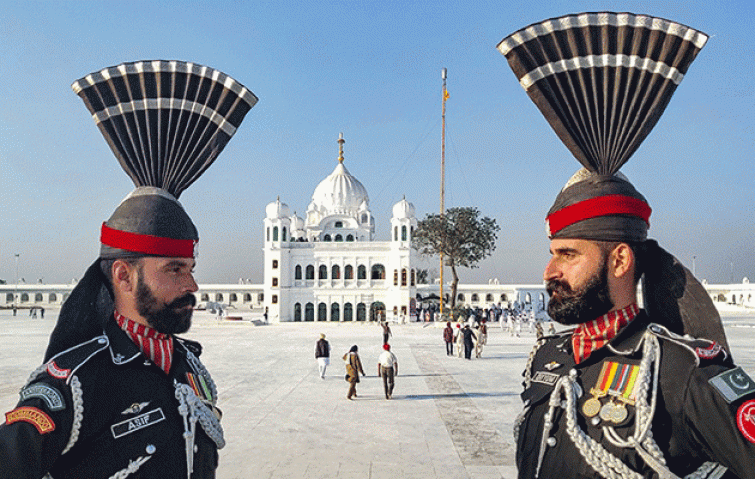
Inaugurated on November 9, 2019, by Prime Minister Narendra Modi, the Kartarpur Corridor fulfilled a decades-long dream of millions of Sikhs around the world. It enabled visa-free access for Indian pilgrims to visit Gurdwara Darbar Sahib, located in Kartarpur, Pakistan's Narowal district, just four kilometres from the international border.
The day of the inauguration held deep spiritual resonance, coinciding with the 550th birth anniversary of Guru Nanak Dev Ji, the founder of Sikhism. On the same day, former Prime Minister Dr Manmohan Singh led an all-party delegation across the newly opened passage, underscoring the corridor’s spirit of faith transcending political divisions.
For many, the opening of the corridor symbolised a rare gesture of goodwill between two nations often at odds. It became an enduring representation of “sewa” (service), “shanti” (peace), and “shraddha” (devotion) — the core Sikh values that inspired the project’s creation.
Historical roots: From division to reconnection
The idea of reconnecting the Sikh community with Guru Nanak’s final resting place dates back to 1947, when the Partition of India divided Punjab between India and Pakistan. The Gurdwara Darbar Sahib, where Guru Nanak spent the last 18 years of his life and attained joti jot (spiritual merger), fell on the Pakistani side of the border, while Dera Baba Nanak remained in India.
For decades, devotees could only glimpse the shrine from viewing platforms on the Indian side, separated by barbed wire and political barriers. The longing for access persisted across generations, transforming into a collective spiritual aspiration.
In 1999, during the 550th birth anniversary celebrations of Guru Nanak, both nations began informal discussions about building a corridor. Two decades later, the vision became reality — a testament to diplomacy grounded in faith.
The corridor's global significance
The corridor soon attracted international attention. In February 2020, United Nations Secretary-General António Guterres visited the site, describing it as a “corridor of hope” and a model for how faith-based connections can promote peace and understanding. The area around Dera Baba Nanak, in Punjab’s Batala police district, has even established a dedicated police station to assist pilgrims and ensure their safety.
Between its opening and the pandemic’s arrival in early 2020, thousands of devotees crossed the border daily, many shedding tears of joy upon seeing the sacred shrine without needing a visa for the first time in their lives.
Closure and uncertain future
The joy, however, has been shadowed by the corridor’s extended closure since May 2025. Security concerns following Operation Sindoor led to an indefinite suspension of movement. For now, pilgrims wishing to visit Darbar Sahib must travel via the Attari-Wagah border and apply for a visa — a process that has reintroduced barriers the corridor had so beautifully removed.
Though governments on both sides maintain the legal framework of cooperation, the resumption of the pilgrimage remains uncertain.
A bridge waiting to reopen
Even in silence, the Kartarpur Corridor continues to resonate deeply in the Sikh psyche. It stands as a living symbol of the belief that faith can cross borders even when politics cannot. For millions, it is not merely a passage of concrete and steel — but a spiritual artery linking hearts divided by history.
As the world marks six years of its inauguration, the hope endures that the “corridor of hope” will once again open its gates — allowing pilgrims to walk freely on the sacred path first envisioned by Guru Nanak Dev Ji himself.