Saturday, Jan 17th 2026

India's Leading News & Views Website
Health
By FnF Correspondent | PUBLISHED: 03, Dec 2025, 9:44 am IST | UPDATED: 03, Dec 2025, 9:44 am IST
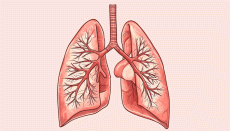
 Anyone living in Delhi, Mumbai, or any northern Indian city during winter has felt it: The burning eyes, heavy chest, and the strange fatigue that sets in after just a short walk outdoors. When the Air Quality Index (AQI) crosses 400, it enters the “severe” range, meaning the air is hazardous even for healthy individuals. But while the symptoms feel external, the most dramatic changes are happening inside your lungs.
Smog contains microscopic particulate matter, referred to as PM2.5 and PM10, small enough to bypass your nose and throat to settle directly into the lungs.
As Dr Nana Kunjir, Consultant Pulmonologist and Intensivist, Sahyadri Super Speciality Hospital, Pune, says, "These particles are of such a small size that they reach the lungs without any barrier and thus can be found in the blood gradually."
Once inside, they initiate an inflammatory response and worsen lung function. Over time, this leads to structural damage and reduced capacity to exchange oxygen, setting the stage for chronic disease.
The lungs are lined with tiny hair-like structures (cilia) that sweep mucus, bacteria and pollutants out. High-pollution exposure breaks or paralyses cilia, reducing this vital defence mechanism.
Dr Kunjir notes: “The tiny hair-like structures in the lungs known as cilia… get broken as well. Consequently, there is less resistance to infections.”
This is why smog season feels like “everyone is getting sick” The body simply can’t keep microbes out.
A 2023 review in Lancet Respiratory Medicine highlighted that long-term PM2.5 exposure increases lower respiratory infections by up to 44%, particularly pneumonia.
PM exposure doesn’t just irritate, it transforms the respiratory lining.
According to Dr Kinjal D. Modi, Consultant Pulmonary Physician, P. D. Hinduja Hospital and MRC, Khar: Prolonged PM10 exposure leads to “reactive bronchiolar surface epithelium” and “chronic inflamed secretion, leading to chronic bronchitis.”
People with asthma, COPD, or bronchiectasis experience rapid deterioration during smog periods. Even healthy lungs can develop acute bronchitis if exposed long enough.
Pneumonia is no longer just a winter infection; it has become a pollution-linked outcome.
Dr Kunjir explains: “Continuous inhalation of such air results in the irritation of the respiratory tract and inflammation… and the chances of infections such as pneumonia increase.” The lungs fill with fluid, breathing becomes difficult, and weakened immunity makes recovery slower and more complicated.
The impact isn’t local, it’s systemic. “Being exposed to polluted air for a long time causes the body to be in a state of stress and inflammation, thereby weakening the immune system further,” explains Dr Kunjir.
Studies in Environmental Health Perspectives show that high PM2.5 exposure reduces circulating immune cells and impairs their function, making infections harder to fight.
This is why winter becomes a perfect storm: pollution + viral season + weakened immunity.
Certain groups experience more severe damage:
Clinics experience a surge in these groups, often requiring hospitalisation or prolonged treatment.
N95 masks and air purifiers are essential, but not foolproof. As Dr Modi points out: Masks help, “but the moment you remove your mask while eating or speaking… the protection is gone.”
Air purifiers face similar limitations, cost, incomplete filtration, and brief outdoor exposure make them imperfect solutions.
When AQI crosses 400, every breath becomes an injury, not just an irritation. Microscopic particles reach deep into the lungs, break defence systems, ignite inflammation, and make the body vulnerable to severe infections like pneumonia.
The smog may fade in a week or a month, but as experts warn. “The damage it has caused may still be there,” says Dr Kunjir. The smartest response isn’t panic, it’s protection. Track the air, adjust activity, support your immunity, and don’t delay medical care.
by : Priti Prakash
The year 2025 dawned with New Delhi gazing lovingly into the mirror of its own expectations. After a...