Sunday, Feb 01st 2026


India's Leading News & Views Website
Tourism & Travelogue
By FnF Correspondent | PUBLISHED: 15, Dec 2025, 11:52 am IST | UPDATED: 15, Dec 2025, 11:52 am IST
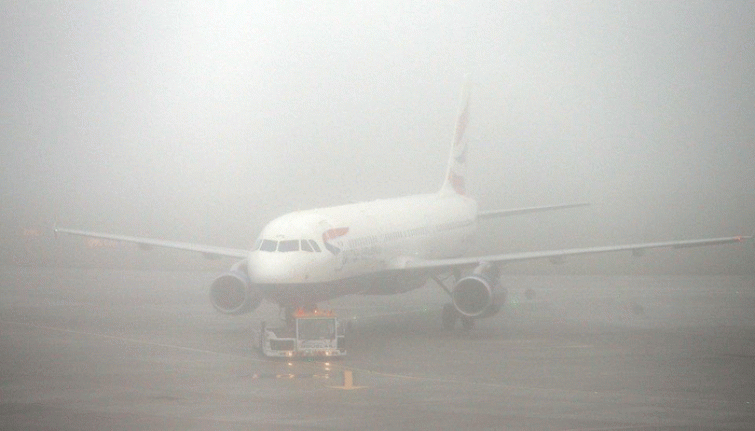 Flight operations at Indira Gandhi International Airport faced disruptions early Monday after dense fog mixed with toxic smog significantly reduced visibility, leading to delays in several arrivals and departures. The impact was felt during peak morning hours with zero visibility.
 In a statement, IndiGo said low visibility conditions over Delhi could affect flight timings and assured passengers that its teams were closely monitoring weather developments to ensure safe operations. The airline requested travellers to check flight status through official channels and thanked them for their patience amid challenging conditions.
“Low visibility and fog over Delhi will impact flight schedules. We're keeping a close watch on the weather and doing our best to get you where you need to be, safely and smoothly. We request you to stay updated on your flight status via our website or app. Be assured, our teams are here to assist you at every step and ensure support. Here's hoping clearer skies help us serve you better soon and thank you for your patience and understanding during this challenging time,” the airlines said.
Air India also flagged disruptions, noting that poor visibility due to dense fog was affecting flights in Delhi and parts of northern India. Passengers were advised to verify flight details before heading to the airport.
“Poor visibility due to dense fog is impacting flight operations in Delhi and parts of Northern India. Please check your flight status before heading to the airport,” posted Air India.
According to the latest statement by the Delhi airport, at least 40 flights have been cancelled and four have been diverted.
The flight disruptions came as Delhi woke up to hazardous air quality, with the AQI recorded at 493 at 7 am, placing the city in the ‘severe-plus’ category, according to the Central Pollution Control Board (CPCB). Such levels pose serious health risks, particularly to children, the elderly and those with respiratory ailments.
Air quality had already deteriorated sharply a day earlier. On Sunday, 38 out of 39 active monitoring stations in the Capital reported air quality in the ‘severe’ or ‘severe-plus’ range for extended periods.
At Wazirpur, Rohini and Ashok Vihar, the 24-hour average AQI touched 500, the highest limit measurable under CPCB standards. Experts warn that since readings are capped at 500, actual pollution exposure especially during peak hours may have been even higher.
Several localities hovered just below the maximum mark. Jahangirpuri and Mundka recorded an AQI of 499, followed by Bawana (498), Delhi Technical University and Vivek Vihar (497), Narela (493) and Anand Vihar (492).
Other severely affected areas included IHBAS, Dilshad Garden (491) and Okhla Phase-2 (490). Even Shadipur, which posted the lowest AQI of the day, recorded 375, categorised as ‘very poor’.
With pollution crossing emergency thresholds, the Commission for Air Quality Management (CAQM) has imposed Stage-IV of the Graded Response Action Plan (GRAP) across the National Capital Region. This highest level of restrictions is triggered when AQI breaches 450 and is aimed at preventing further deterioration.
Under GRAP-IV, all construction and demolition activities have been halted across Delhi-NCR. Authorities have also ordered the closure of stone crushers, mining operations and allied units, key contributors to dust pollution.
Vehicular restrictions have been tightened, with BS-III petrol and BS-IV diesel four-wheelers barred from operating in Delhi and neighbouring districts including Gurugram, Faridabad, Ghaziabad and Gautam Buddha Nagar.

by : Priti Prakash
The year 2025 dawned with New Delhi gazing lovingly into the mirror of its own expectations. After a...