 New Delhi:
 In Dhaka, hundreds of protesters, under the banner of "July Oikya (July Unity)", began marching towards the Indian High Commission on Wednesday afternoon, raising anti-India slogan and pressing several demands, including prevention of 'anti-Bangladesh conspiracies' and the return of former PM Sheikh Hasina.
In a further development the Indian Visa Application Centre in Dhaka suspended its operations from the afternoon due to the prevailing security situation..
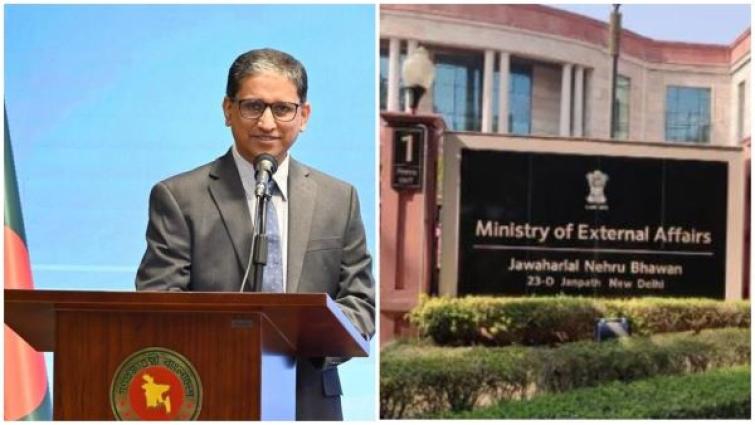
On December 17, 2025 New Delhi formally summoned Bangladesh’s High Commissioner to issue a demarche after reports that 'certain extremist elements' in Dhaka had announced plans to create a security situation around the Indian High Commission — including a planned march toward the diplomatic compound and alarming threats circulating on social media and messaging platforms.
In its official statement, the MEA said, “The Bangladesh High Commissioner … was summoned and apprised of India’s strong concerns at the deteriorating security environment in Bangladesh. His attention was drawn, in particular, to the activities of some extremist elements who have announced plans to create a security situation around the Indian Mission in Dhaka.”
The MEA’s demarche was not merely a security protest but also a strategic message. In addition to expressing concern, India’s official statement made these key points, “India completely rejects the false narrative sought to be created by extremist elements regarding certain recent events in Bangladesh.”
It said, “It is unfortunate that the interim government has neither conducted a thorough investigation nor shared meaningful evidence with India regarding the incidents.”
Calling for the safety of its officials it stated in clear diplomatic terms, “We expect the interim government to ensure the safety of Missions and Posts in Bangladesh in keeping with its diplomatic obligations.”
MEA also reiterated a familiar refrain that 'even amid tension it remains committed to peace, stability and the conduct of free, fair and inclusive elections in Bangladesh, scheduled for 12 February 2026'.
This emphasis on elections is significant. New Delhi is signalling that instability not only poses security risks but also threatens democratic processes in a neighbouring state with which it shares deep historical ties.
What triggered the demarcheTwo connected dynamics produced the immediate trigger. First, domestic political turbulence in Bangladesh where an interim government is preparing parliamentary elections on February 12, 2026 — has sharpened street mobilisation, polarised public discourse, and produced inflammatory rhetoric by some political and student leaders. Reuters and several Indian outlets link the protests and anti-India sloganeering to this fraught pre-electoral environment, making Indian diplomatic premises a focal point for demonstrators seeking visibility.
Second, there were concrete security incidents and operational concerns. Large anti-India demonstrations in Dhaka that briefly moved toward the Indian High Commission, the temporary suspension of consular operations (visa centre closures) in Dhaka because of the security situation, and reportedly credible social-media/phone threats against the mission. That combination — violent mobilisation plus direct threats — is what prompted the MEA to act.
The envoy’s responseIn response to the demarche in New Delhi, High Commissioner M. Riaz Hamidullah struck a conciliatory but firm tone during public engagements. At a Victory Day celebration at the Bangladesh Embassy, he stressed that “the entire nation of Bangladesh is committed to the aspirations of its people, particularly the youth.”
Hamidullah reiterated the mutual interdependence of India and Bangladesh saying, “We believe our relationship with India is in our shared interest. We have mutual interdependence, with a shared emphasis on regional prosperity, peace, and security.”
The envoy’s language is noteworthy. While he did not dismiss Indian concerns, he reframed them in terms of long-term cooperation, stressing that both nations have much to gain from a stable, peaceful neighbourhood.
This diplomatic balancing act reflects Dhaka’s awareness that outright rejection of India’s demarche could inflame tensions further
Strategic analysis: immediate and medium-term impactOne, short-term friction and operational disruption, real impact is practical. Consular operations and public diplomacy are the first casualties. Closure or suspension of visa services, heightened security at missions, and additional procedural friction will inconvenience travellers, students, businesses and diplomats on both sides and feed negative media cycles. That operational friction can rapidly translate into reciprocal diplomatic irritants if local protests recur.
Two, political signalling and domestic optics- For New Delhi, the demarche is both a security demand and a diplomatic signal. India must be seen protecting its mission and asserting that it won’t tolerate threats to its diplomats.
For Dhaka’s interim authorities, handling this issue poorly would risk domestic political costs (appearing weak on security) and international costs (being seen as unable to protect foreign missions). The episode therefore tightens the link between Bangladesh’s domestic political calculus and bilateral diplomacy, raising the volatility of routine interactions.
Three, risk to strategic cooperation — India and Bangladesh cooperate across counter-terror, border management, trade and energy. Repeated security incidents or a narrative that India tolerates anti-Bangladesh activity from its soil (which India denies) can erode mutual trust and make cooperation more transactional. New Delhi’s public insistence on credible investigations suggests concern that unresolved incidents could harden Bangladesh’s posture and that, in turn, may slow joint projects or intelligence sharing.
Four, opportunity for calibrated diplomacy — This is also a moment for crisis-management. A clear, evidence-based channel between the two foreign ministries can prevent one or two incidents from spiralling. If Dhaka conducts transparent investigations and tightens protection for missions, and if India limits rhetoric to measured diplomatic protest, relations can return to the baseline of pragmatic cooperation. The envoy’s conciliatory framing — stressing interdependence and shared prosperity — points exactly to the tone that would stabilise ties.
Bottomline
The demarche reflects a predictable though serious escalation. Domestic political turbulence in Bangladesh has spilled into threats against Indian diplomatic premises, prompting New Delhi to insist on protections that are non-negotiable under the Vienna Convention.
The immediate effect is operational disruption and heightened diplomatic vigilance. The medium-term effect will depend on whether Dhaka can provide credible, transparent responses and prevent extremist mobilisation from targeting bilateral ties. If both capitals choose containment and technical cooperation over rhetoric, the episode can be managed. If it becomes a headline-driven tit-for-tat, it could slow cooperation at a time when regional stability would benefit from steady India–Bangladesh engagement.